

We (Sarah and Russell) bought our 1953 brick Cape Cod house in 1991. The house was originally heated with oil and after only a few years, we replaced the oil furnace with a gas furnace. We also have air conditioning for the house and that gets used almost non-stop from June -August. Baltimore summers are hot and humid. We have been concerned about global warming and the health of our planet for some time, and that prompted us to collect rainwater, compost, eat mostly vegetarian, take short showers, and fix things that are broken. And we’ve saved energy by hanging our wet, clean clothes on the two clotheslines we have in our back yard. But until we started growing out of our two-bedroom house (after having two boys) our “green ways” had not really caused us to change our house.
Remodel improves energy efficiency
But in 2007, with an 8 and 12 year old sharing a bedroom, we decided it was time to add more space and specifically a new second story. Besides adding three more bedrooms and a bath, it was a perfect opportunity to make our home more energy efficient. Most importantly, we enhanced the insulation and replaced all 17 windows on the first floor, along with 14 new windows on the second floor. These changes made a big difference for our heating and cooling bills!
To heat and cool the new second story, our architect recommended a “heat pump.” We weren’t familiar with those at the time, but went with it and now have had a heat pump for 16 years – longer than anyone we know! And happy to say that we’ve had no problems. When it is really cold here in Baltimore, the heat pump can run almost non-stop, and the heat pump can struggle to cool on the really hot (over 100 degrees) days as well. Let’s hope that we can keep those days to a minimum.

There was one other critical part of our remodel. We were interested in installing solar panels at some point in the future. So, our architect designed our house with a large roof area facing south for that specific reason. We thought it would be great to make our own electricity from the sun and happy that we thought ahead and pushed for it!
Producing our own electricity!
Jumping to 2021, we finally decided to take advantage of that south facing roof and installed a 21 panel 7.7 kW solar system (details below). We chose Maryland Solar Solutions because it had been in business for over 20 years and is woman-owned. The system is large enough to supply all our electricity needs for some months of the year and a lot of our electricity needs for the rest of the year. Regarding the finances: the system cost $25K but we received state and county rebates totally $6K as well as a tax credit (typically 30%). Our average monthly electricity use (for one year prior to having solar panels) was 657 kWh and now our average monthly use is 191 kWh. Past average monthly electric bills were about $83 ($250 for a high) and now the average is $22. In the months we produce extra electricity, we sell it back to BGE and get a small check.
Electrifying our driving:
We bought the all-electric Subaru Solterra in February of 2023 for Russell to use to commute to work each day (50 miles round trip). Since our daily mileage is pretty low, we started off charging with a standard 110 outlet (slow charger), but eventually added an Emporia Level 2 charger. On the days when we use the car for a longer trip and the range gets down to 50 miles, the Level 2 charger is noticeably faster to charge the car back up to about 80% of the full charge.
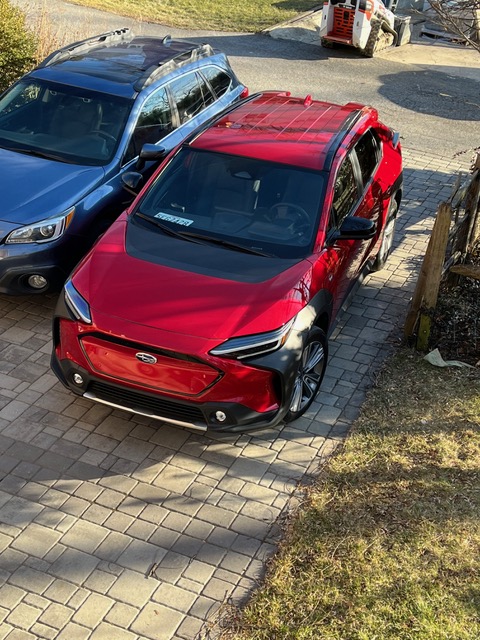
There were two EVs that we looked at (VW ID.4 and the Solterra) that could accommodate Russell’s need to put lots of model airplanes in the back. We chose the Solterra because we liked the feel and inside styling the best, as well as the price. The range is not as good as a Tesla but the Solterra meets our main needs for commuting to work and around town. It handles well, has great pick-up, and we got it in a fun red color. We have no complaints about the car. We do have a gas-powered second car that we use for trips that are not set up for charging.
Current zero emission features:
- Windows: Marvin Clad Aluminum frame, dual-pane windows (Next Generation).
- Heat pump (upstairs): Rheem 13 Seer Series 1-1/2 to 5 tons
- Solar: 7.7 kW PV system. 21 panels are REC365AA modules with a SolarEdge inverter
- Car: 2023 Subaru Solterra, dual motor, 215 horsepower, 222-227 miles of range.
- Charger: Emporia Level 2 EV Charger, 48 Amp, 11.5 kW
With the various improvements we’ve made our gas usage is down to about 5 therms/month (very low) for seven months of the year, but jumps up from Dec-Feb to heat the downstairs.
Remaining goals & challenges:
Next on our list is an induction stove. After reading articles on the dangers of gas stoves, I started to worry that the fumes from the stove may impact our health, especially in the winter months when we have a more sealed up house. We have a gas stove (Dacor) that works well but it will be replaced in the next few months. I bought an induction burner to see if I liked it and it boils water quickly and it is easy to use (and I don’t smell gas!!!).
When our gas dryer dies we will replace it with an electric one. We still have a gas furnace for the first floor heat and a gas on-demand hot water heater for the house. Our second car is a Subaru Outback. We will see how we do travelling with the Solterra to see if we replace the Outback with another electric or a hybrid car.
 ZERO30CLUB.ORG
One response to “Transitioning a 1953 Cape Cod to the Future”
Love that you asked your architect to create a south-facing roof for solar that was installed 14 years later!
LikeLike